The Ultimate Golden Circle Iceland Travel Guide

25.06.2025 (Updated: 27.04.2026, 13:24)
27.04.2026


Top Golden Circle Stops: Þingvellir National Park, Geysir geothermal area, and Gullfoss waterfall are the must-see highlights of this famous Iceland route.
Extended Adventure: Add iconic sites like Seljalandsfoss, Skógafoss, Reynisfjara black sand beach, and Jökulsárlón glacier lagoon for a full Iceland road trip experience.
Best Way to Travel: Renting a car in Iceland gives you flexibility and freedom to explore at your own pace—Saga Car Rental offers reliable 4x4s, SUVs, and compact cars for every route.
Why It’s Worth It: The Golden Circle combines breathtaking waterfalls, erupting geysers, and rich history—all within a short drive from Reykjavík.
The Golden Circle is Iceland’s most famous sightseeing route, a roughly 300-kilometer loop from Reykjavík that lets you witness geysers erupting, thundering waterfalls, and even walk between continents – all in a single day. So it’s worth exploring the many things to do in Reykjavík before or after your Golden Circle adventure. It’s a bucket-list day trip for anyone visiting Iceland. The name “Golden Circle” ( Gullni hringurinn ) comes from Gullfoss (“Golden Falls”), one of its star attractions. This guide will walk you through everything you need to know – from the main stops and hidden gems to the best time to visit, travel tips, tours, and FAQs – to plan the perfect Golden Circle adventure .
Thingvellir fissure, Gullfoss waterfall, Strokkur geyser, and Kerið crater (clockwise from top-left) – four highlights of Iceland’s Golden Circle.
The Golden Circle is a circular driving route in southwest Iceland , easily reachable from Reykjavík. It covers three must-see attractions : Þingvellir National Park , the Geysir Geothermal Area , and Gullfoss Waterfall . Many itineraries also include the nearby volcanic crater lake Kerið as a bonus stop. The entire loop is about 230–300 km (140–186 miles) depending on detours, and you can drive it in one day. Most travelers allocate 6 to 8 hours to fully enjoy each site and the scenic drives between them. The route is paved and well-maintained, making it accessible year-round – though winter travel may require extra caution (more on that later). In short, the Golden Circle encompasses many of Iceland’s natural wonders in one trip: think tectonic rift valleys, geothermal hot springs, and roaring waterfalls all within a few hours’ drive.
For one, these sights are incredibly diverse yet close together – you go from watching spurting geysers to standing next to a massive waterfall , to exploring a historic valley between continents , all in a single day. Secondly, it’s convenient: you can self-drive the route with a rental car or join any number of guided tours from Reykjavík that run year-round. The Golden Circle’s short distances and easy road access make it an ideal introduction to Iceland’s nature for visitors of all ages. Whether you choose to drive at your own pace or sit back on a bus tour, you’re in for a day of unforgettable landscapes and natural history.
The classic Golden Circle itinerary features three primary attractions , often called the “Big Three.” These are the stops you absolutely shouldn’t miss:
Þingvellir is a UNESCO World Heritage Site and the first stop heading east from Reykjavík. It is Iceland’s most significant historical site as well as a geological wonder. This is where Iceland’s first parliament, the Alþingi , was established in the year 930 AD – making it one of the world’s oldest parliamentary sites. Þingvellir was also where Iceland proclaimed its independence in 1944, so it’s a place deeply woven into the nation’s identity.
But Þingvellir’s geography is just as fascinating. The park sits in a rift valley at the meeting point of the North American and Eurasian tectonic plates . As the plates slowly drift apart (about 2 cm per year), they’ve created dramatic cliffs and fissures across the landscape. One of the most famous is the Almannagjá gorge , a huge crack where you can quite literally walk between two continents. Standing in this valley, with rocky walls towering on each side, is an awe-inspiring experience.
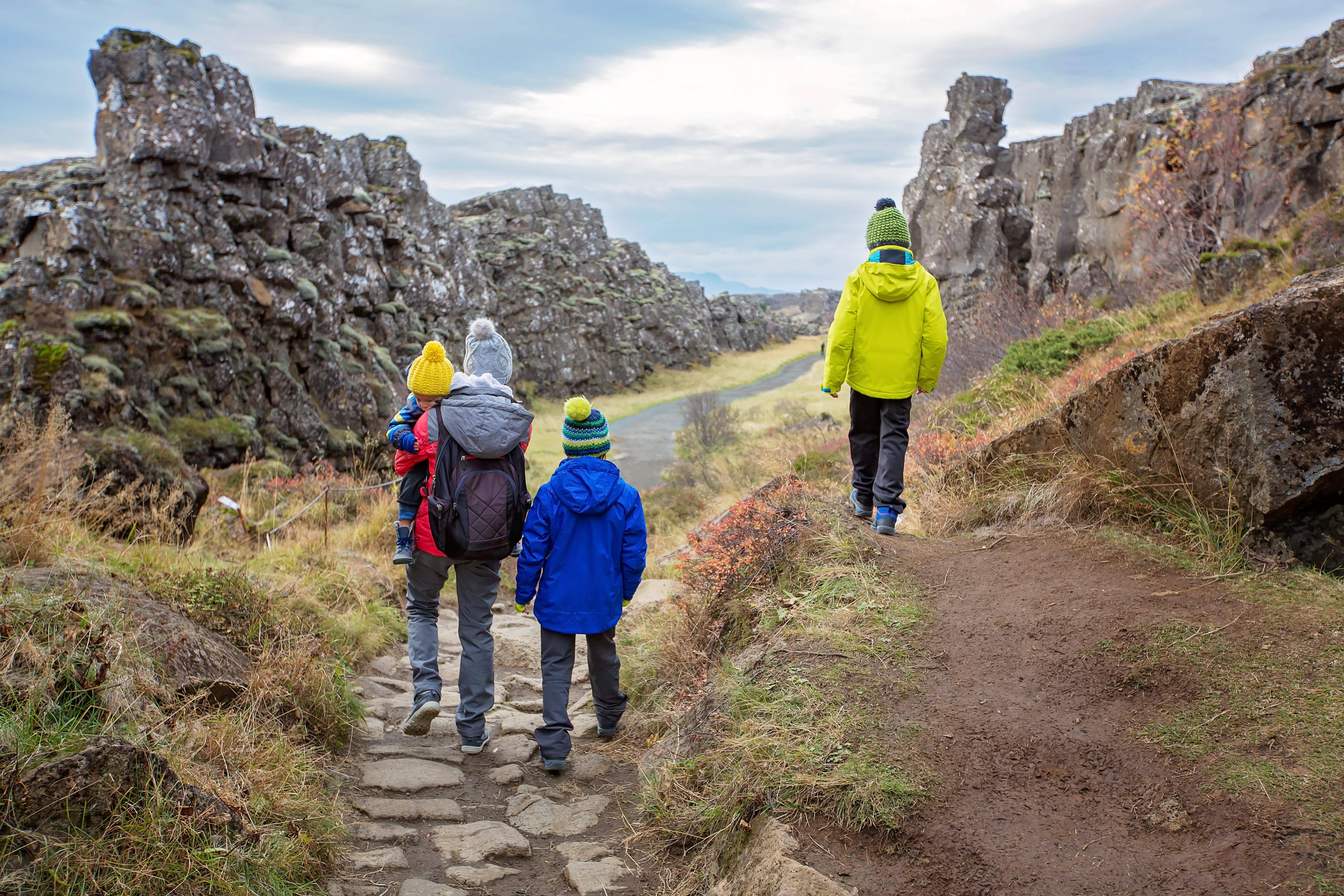
Family walking along a stone path through the Almannagjá gorge in Þingvellir National Park, Iceland, between dramatic volcanic cliffs
Nature lovers will also find plenty to enjoy. Within Þingvellir flows the Öxará river , forming the picturesque Öxarárfoss waterfall – a short hike from the visitor center rewards you with a view of this falls tumbling over black basalt cliffs. The park sits on the shore of Þingvallavatn , Iceland’s largest natural lake, known for its clear waters. In fact, one of Þingvellir’s most unique activities is snorkeling or diving in Silfra , a crystal-clear fissure between the tectonic plates. The water in Silfra is spring-fed and so pristine that visibility can exceed 100 meters! Swimming here (in a drysuit) allows you to literally glide between continents underwater – a bucket-list adventure for many.
Practical tips for Þingvellir: There’s no entry fee to the national park, but there is a small parking fee (around 1000 ISK) at main lots. The park has a visitor center with informative displays, restrooms, and a cafe. Plan to spend ~1 hour if you’re just walking the main path and seeing Öxarárfoss, or longer if you hike or join a snorkeling tour. From Reykjavík, Þingvellir is only about a 45-minute drive (47 km) via Route 36. It’s usually the first stop on tours, so arriving early (before 10am) or later in the afternoon can help avoid the biggest crowds.
After Þingvellir, most travelers continue northeast to the geothermal valley of Haukadalur , home to the Great Geysir and its lively little brother Strokkur . This area is often just called “Geysir” – and in fact, it’s the very place that gave rise to the English word geyser . The Great Geysir has been active for centuries (since at least 1294) and was once one of the tallest geysers in the world. Today Geysir itself is mostly dormant (only occasionally spouting), but right next to it is Strokkur , which erupts like clockwork every 5–10 minutes! Strokkur blasts boiling water up 20–30 meters (65–100 feet) into the air, delighting onlookers who cluster around with cameras ready. You’ll know an eruption is coming when you see the pool begin to dome and boil – then WHOOSH, a column of water shoots skyward (and sometimes douses bystanders with mist, to everyone’s squealing delight).
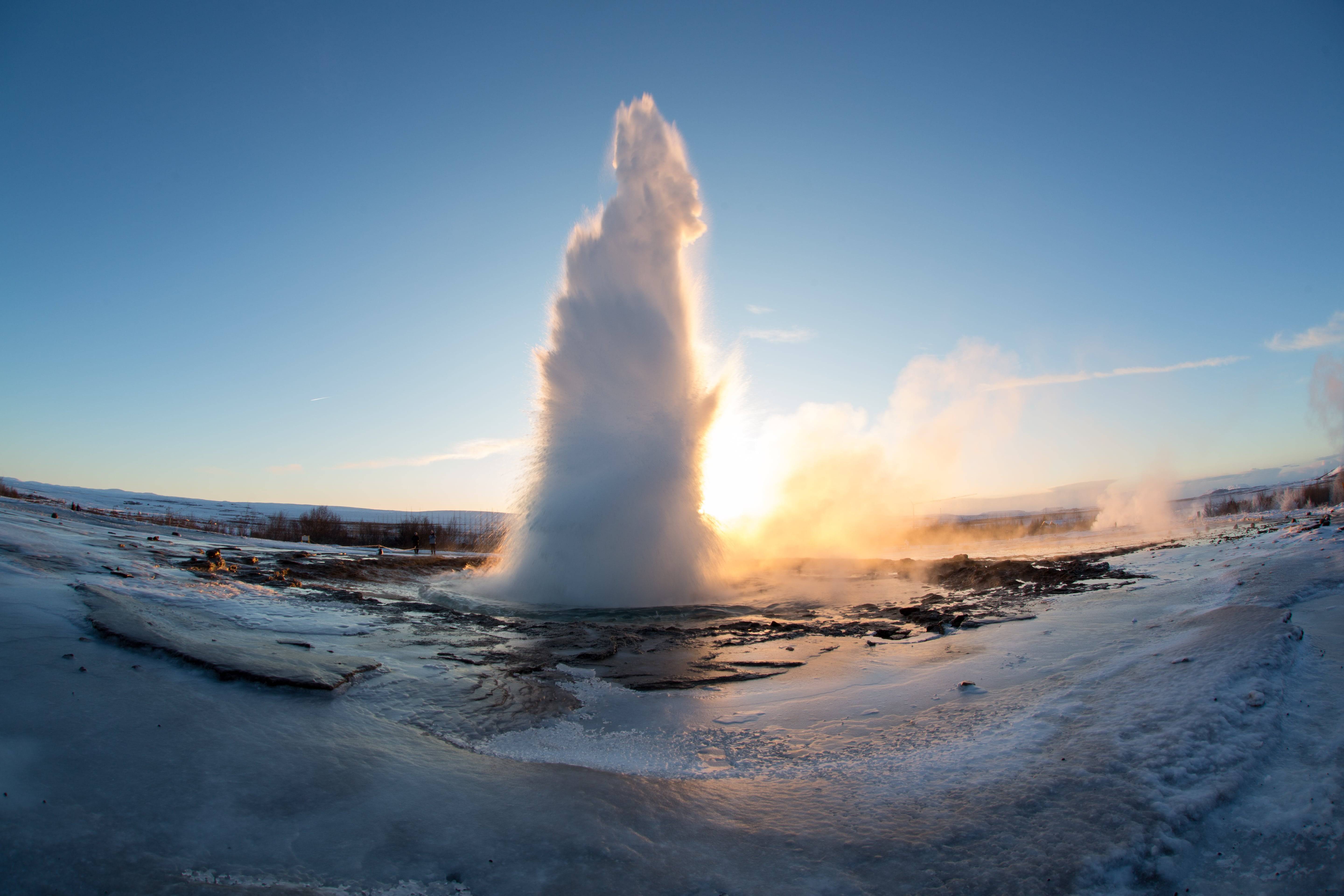
Strokkur geyser erupts every few minutes at Geysir geothermal area, shooting boiling water up to 20–30 meters high.
The Geysir geothermal area is a steaming, otherworldly landscape. As you walk the footpaths, you’ll see bubbling hot springs , hissing fumaroles (steam vents), and colorful mineral deposits in the soil. Aside from Strokkur and the dormant Geysir, there are several smaller geysers and pools—names like Litli-Strokkur and Smiður —that simmer or spout on a lesser scale. The ground is warm underfoot and often smells of sulfur (that “rotten egg” odor typical of geothermal areas). Be sure to stay on marked paths , both for your safety and to protect the fragile ground.
This site has free admission and is open 24/7, so you can visit any time, even at night to see an eruption under the stars or (if you’re lucky) under the northern lights. On site, across the road from the hot springs, there’s a large complex with a parking lot, restaurant, café, restrooms, and gift shop – convenient for a lunch or coffee break. From Þingvellir, driving to Geysir takes about 50 minutes (60 km) via Routes 36/365 and 37. Gullfoss is just a further 10-minute drive past Geysir, so these two are usually paired one after the other. Expect Geysir to be busy during mid-day (when tour buses arrive), but since eruptions are so frequent, you’ll get a great view of Strokkur with just a bit of patience.
Last (but certainly not least) on the Golden Circle is Gullfoss , the “Golden Falls.” This spectacular two-tiered waterfall is one of Iceland’s most iconic sights – you’ll hear its roar long before you see it. The Hvítá river, fed by the Langjökull glacier, plummets in two stages at Gullfoss: first a drop of 11 meters, then a second drop of 21 meters, into a deep canyon. The result is a thunderous cascade of water disappearing into a rugged gorge, often throwing up mist and rainbows on sunny days.
Gullfoss is so powerful that standing at the viewing areas, you’ll feel the rumble in the ground. In summer, up to 140 cubic meters of water pour over the falls each second – a truly awe-inspiring force of nature. In winter, parts of Gullfoss freeze into shimmering icicles, creating a magical scene (and sometimes an ice bridge forms in the gorge). There are two main viewpoints : an upper viewing platform near the parking lot, which gives a panoramic overview, and a lower trail that leads closer to the waterfall’s edge for a dramatic up-close perspective. (Note: The lower path is often closed in slippery winter conditions.)
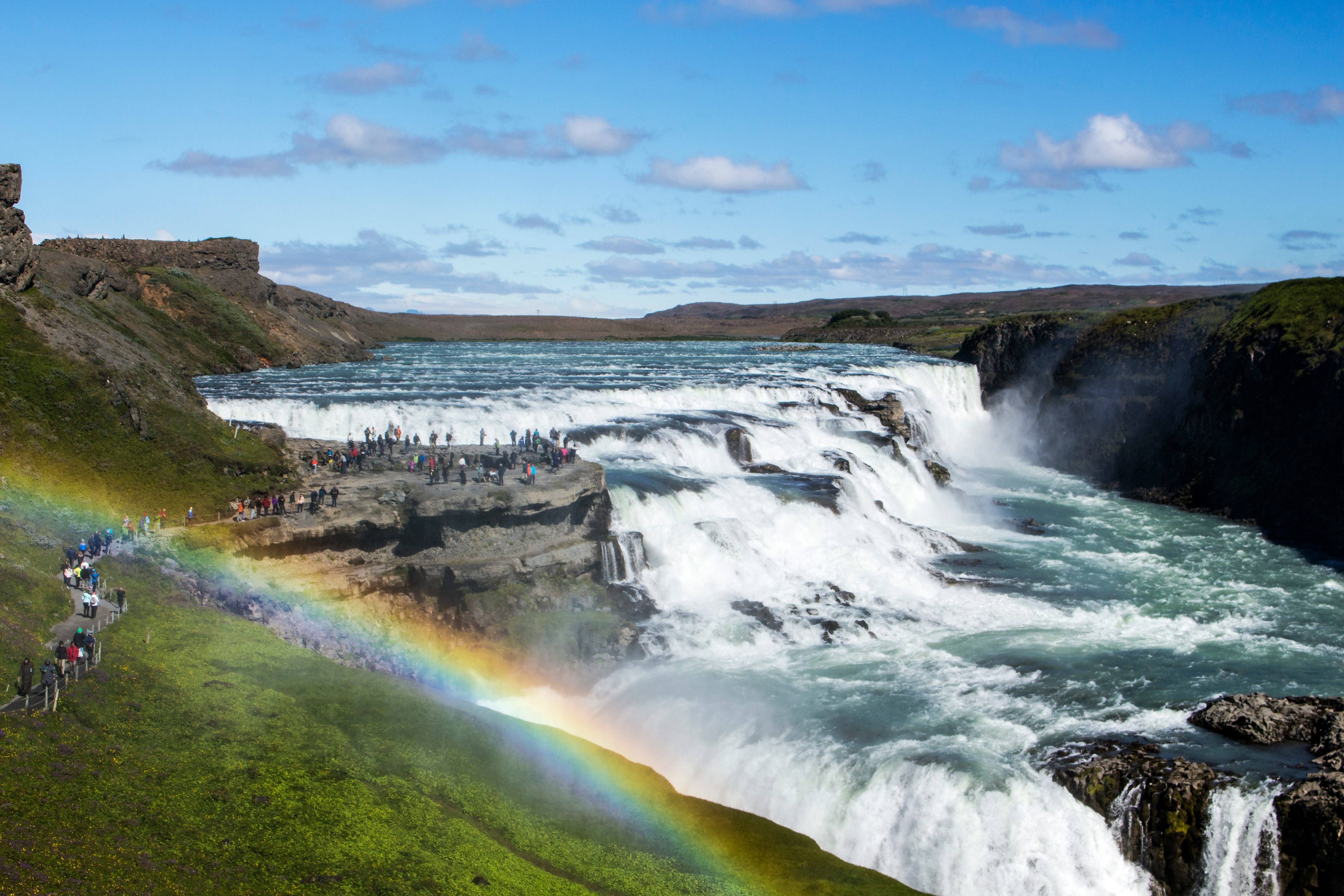
Gullfoss (“Golden Falls”) thunders into the Hvítá canyon in two cascades. In the early 20th century it was nearly dammed for a hydroelectric project, but was saved by local heroine Sigríður Tómasdóttir.
A bit of history: Gullfoss was almost lost to development. In the early 1900s, foreign investors wanted to harness the waterfall for hydroelectric power. Legend has it that Sigríður Tómasdóttir , the daughter of the farmer who owned the land, fought tirelessly to protect Gullfoss – even threatening to throw herself into the falls if they were destroyed. Ultimately, the plans fell through and Gullfoss was preserved in its natural state. Today a memorial to Sigríður stands at the site, honoring Iceland’s first environmental activist.
Visiting Gullfoss is free (no entrance fee, and parking is free as well). There is a large parking area and a visitor center with restrooms, a café, and a gift shop near the upper viewpoint. Prepare for spray – a waterproof jacket is smart here, as the mist from the falls often drifts over the paths. It’s also windier and cooler by the waterfall, so an extra layer is a good idea. From Geysir, Gullfoss is only about 10 km up the road (10–15 minutes’ drive). Many tours make this the turnaround point before heading back to Reykjavík. If you’re driving yourself, you can return to Reykjavík by looping south via roads 30 and 35 through the town of Selfoss (completing the circle), or simply backtrack the same way you came. Either way, it’s about 1.5 hours drive from Gullfoss back to the capital.
Many Golden Circle itineraries include a stop at Kerið , a striking volcanic crater about 15 km off the main route (often visited on the return leg). Kerið is a 6,500-year-old crater, approximately 270 meters across, with steep circular slopes of red volcanic rock enclosing a vivid blue-green lake at the bottom. It’s photogenic and easy to visit – you can walk right up to the rim from the parking area and even hike down a path to the lake’s edge. The contrast of red earth, aquamarine water, and (in summer) green moss makes for stunning pictures.
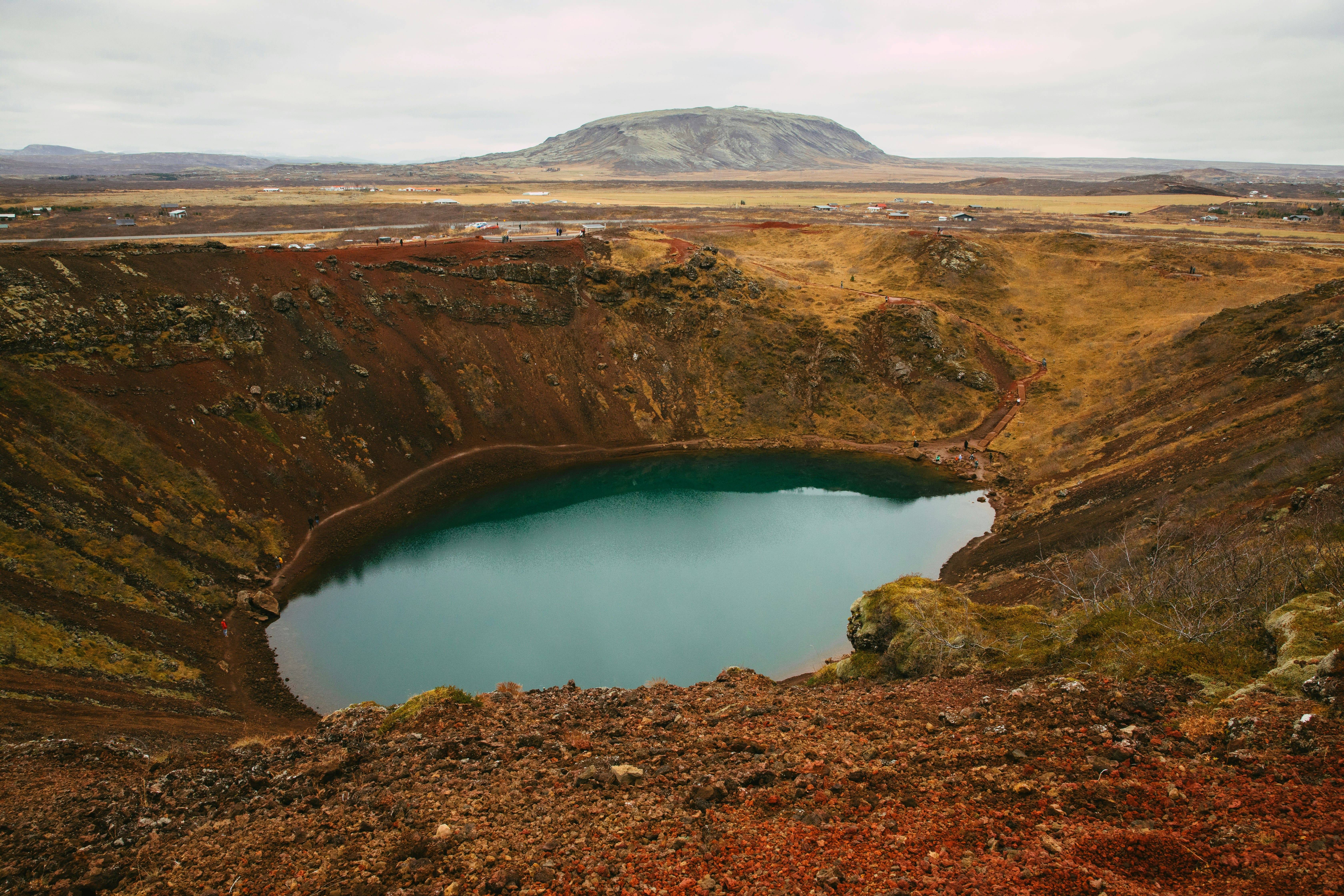
Do note that Kerið is privately owned and charges a small entrance fee (about 400 ISK, roughly $3) to help with its upkeep. The site is open during daylight hours (approx. 8:00–21:00 in summer, shorter hours in winter). There are no facilities aside from a parking lot, but the visit usually only takes 20–30 minutes. If you have time, Kerið is well worth the stop to round out your Golden Circle with a unique geological sight. Many guided tours now include Kerið in their Golden Circle day trip itineraries by popular demand.
While the three main sites above are the headline attractions, the Golden Circle region is packed with other interesting stops . If you have a full day or want to explore a bit off the beaten path, consider adding one or more of these detours to your route. They’re all located near the main loop or on the return drive, and can enrich your trip with extra experiences:
These are just a few of the many additional stops you could include. Others include the Efstidalur farm (family farm with ice cream parlor and farm-to-table restaurant), the eco-village of Sólheimar , or hikes like the Reykjadalur hot spring river near Hveragerði. If you have extra days, you might even explore beyond the Golden Circle to places like the South Coast or Silver Circle – but those are adventures for another guide!
One of the great things about the Golden Circle is that it’s a year-round destination . Each season in Iceland offers a different experience, and the Golden Circle is accessible in all seasons – you just need to prepare accordingly. Here’s a breakdown of what to expect:
The most popular time to visit.
The Golden Circle becomes a snowy wonderland in winter.
A shoulder season offering a bit of the best of both summer and winter.
Spring in Iceland is a time of transition.
In summary there’s no bad time to do the Golden Circle . Summer offers ease and midnight sun (and crowds), winter offers snow and auroras (with challenges), and the shoulder seasons offer balance and breathing room. Choose the season that fits your wider travel plans – but rest assured, the Golden Circle’s beauty shines year-round. Just dress appropriately, plan with the daylight in mind, and you’ll have an amazing trip.
One big question is whether to drive yourself or join a guided tour . Both options are very popular, and each has pros and cons:
Renting a car and driving the Golden Circle on your own gives you maximum flexibility . The roads on the standard route are paved and generally easy to drive. In summer, a small 2WD car is sufficient for the Golden Circle. In winter, it’s advisable to have a 4WD vehicle with winter tires, as conditions can be icy or snowy. Driving yourself means you can set your own schedule : spend extra time at places you love, take detours on a whim, and perhaps start very early or stay late to dodge the tour bus crowds. Many travelers choose to depart Reykjavík early in the morning to enjoy popular spots before peak hours. Another self-drive perk is the ability to discover roadside surprises – you might spot Icelandic horses and pull over for a photo, or find a farm café that isn’t on the tour itineraries.
Do keep safety in mind: check the weather and road conditions (see vedur.is for weather and road.is for conditions) before heading out, especially in winter. Always keep your gas tank topped up (there are gas stations in towns like Selfoss and Laugarvatn). And beware of Iceland’s notorious winds – hold onto your car doors when opening them, as wind gusts can literally rip doors off hinges! As long as you’re prepared and drive cautiously, a Golden Circle road trip is very manageable for visitors.
Driving times: roughly 3 hours of drive time in total (Reykjavík → Þingvellir ~45min, Þingvellir → Geysir ~50min, Geysir → Gullfoss ~10min, and ~1.5h back to Reykjavík via either route). With stops, plan on a full day of exploration.
The Golden Circle officially starts/ends in Reykjavík. Most self-drivers go Reykjavík → Þingvellir (via road 36) → Geysir → Gullfoss → return via road 35 through Selfoss town (then Route 1 back to Reykjavík). Others simply backtrack from Gullfoss the same way. If you’re staying outside Reykjavík (say, in Selfoss or Laugarvatn), you can of course begin the loop from there. There is no strict direction – it’s a circle! – but clockwise (Thingvellir first) is the classic approach.
Tip: If doing a self-drive day trip, consider ending your day at the Secret Lagoon or Blue Lagoon for a relaxing soak, then head back to the city. Some tour operators even offer drop-off at the Blue Lagoon after the Golden Circle, which is an efficient way to cap off the day.
Exploring nature will definitely build up an appetite, and the Golden Circle has a number of wonderful stops for food and drink – from farm-to-table eateries to casual cafes. Here are some of the best places to eat along or near the route:
(And if you’re just looking for a quick snack: almost every major stop has at least a small café or kiosk. Gullfoss has a cafe inside the shop, Geysir has the whole food court area, and there are gas stations in Selfoss and near Laugarvatn with snacks. But trying one of the local places above will greatly enhance your culinary experience of the day!)
While many visitors do the Golden Circle as a day trip from Reykjavík, you might consider staying a night in the area . An overnight stay allows you to enjoy the sites in the early morning or late evening without crowds, and to explore more leisurely (or catch the northern lights in winter without driving back late). There are accommodations ranging from hotels and guesthouses to farm stays and campgrounds . Here are some top picks:
There are many other options too: guesthouses in Laugarvatn, cabins and cottages for rent around Uthlíð and Minni-Borg, and upscale lodges like Blue Hotel Fagrilundur (a modern hotel near Reykholt). If you love camping, there are campgrounds at Þingvellir, Geysir, and other points (note: camping outside of designated sites is not allowed in this heavily trafficked area). Thingvellir Camping , for example, operates in summer with basic facilities and an awesome natural setting right inside the national park.
Staying overnight in the Golden Circle area can really enhance your experience – you could split the sightseeing over two days, enjoy a late-night hot spring soak, and not rush back to the city. Just be sure to book accommodation in advance, especially in summer, as places do fill up quickly given the popularity of the region.
Given its popularity, it’s no surprise that there is a huge variety of tours available for the Golden Circle. If you prefer not to drive or want to add extra adventures, booking a tour can be an excellent choice. Here’s what you should know:
Types of Tours: You’ll find everything from affordable large-bus tours (with 50+ people) to more intimate minibus tours (10–20 people) to private guided tours in SUVs. All will cover the main three sites, but some make extra stops (like Kerið crater or a farm stop). Some specialized tours are family-oriented (with shorter durations), while others cater to photographers (stopping at the best angles and at optimal times for light). There are also combo tours that include the Golden Circle plus another activity or destination the same day:
It’s wise to book Golden Circle tours in advance , especially for summer travel or any tours with special activities. Many operators offer free cancellation up to 24 hours before, giving some flexibility. Tour prices typically include pickup from major hotels or designated bus stops in Reykjavík. Bring warm layers and rain gear even if it looks clear (guides often have extras, but best to have your own). And don’t shy to ask questions – the guides are passionate locals who often have fascinating stories and facts (like pointing out erupting hot spring history or folk tales of elves at Þingvellir).
No matter which tour you choose, all Golden Circle tours showcase the region’s top natural attractions – you’ll stand in awe of Gullfoss, feel the heat of Strokkur’s spray, and hear about Viking-age gatherings at Þingvellir. The convenience of a tour is that logistics are handled, and you can simply enjoy the scenery and learn along the way. On the other hand, if you’re touring independently, you have the freedom to craft your own experience. Either approach will reward you with incredible memories of Iceland’s Golden Circle.
(Pro tip: If your schedule allows, weekdays can be slightly less busy than weekends for Golden Circle tours. And if you can go in the off-peak season, you might find lower prices and smaller group sizes. But even in peak summer, the tour experience is very well-organized to handle crowds.)
The core Golden Circle route (Reykjavík → Þingvellir → Geysir → Gullfoss and back) is about 230 km (140 miles) round-trip. If you include detours (such as looping by Kerið crater or returning via different backroads), you might drive up to ~300 km. Driving it straight without stops would take roughly 3 to 3.5 hours . However, with stops at the major sights and perhaps lunch, most people spend 6–8 hours to complete the Golden Circle at an enjoyable pace. If you add extra activities or multiple detours, you could stretch it to a very full 10–12 hour day. It’s perfectly feasible as a day trip, but allocate a full day so you’re not rushed – you’ll want time to walk around each site, take photos, and soak in the views.
Yes. The Golden Circle is one of Iceland’s most popular routes and is maintained year-round, so roads are plowed and sanded in winter when needed. Even on snowy days, tour buses and locals drive these roads regularly. That said, winter driving in Iceland requires caution – there can be ice, snow, and limited daylight. It’s recommended to use a 4x4 vehicle in winter and ensure it has studded winter tires. Always check the weather forecast and road conditions before heading out. If there’s a severe storm or heavy snowfall, certain parts (like the road through Þingvellir) could temporarily become challenging. If you don’t have winter driving experience, you might consider joining a guided tour in winter so an expert handles the driving. But on a typical winter day, you can absolutely drive the Golden Circle – just plan for short daylight hours (around 10am–4pm light in mid-winter) and drive slowly and safely. The sights under snow are stunning, and as a bonus, winter means far fewer crowds!
Mostly, yes. The main natural attractions – Þingvellir National Park, Geysir geothermal area, and Gullfoss waterfall – have no entry fees . You can park and walk right in. Þingvellir does charge a parking fee (around 1000 ISK per car) at the major parking lots, and there may be small parking fees at some detour sites. The one notable paid site is Kerið crater , which is on private land and charges about 400 ISK (~$3) per person for entry. Aside from that, your only costs are transport, food, and any optional tours (like snorkeling or snowmobiling) you choose to do. Restrooms at the national park visitor center are free; at Geysir and Gullfoss facilities, they are also free. So yes, you can essentially do the Golden Circle self-guided and just pay for fuel and any extras. If you go with a guided tour , of course that has a cost, but it will include any necessary entrance fees (except things like Kerið, which tours usually include in their price if they stop there). Overall, it’s a very budget-friendly day of world-class sightseeing.
No, the Blue Lagoon is in a different area, not along the Golden Circle. The Blue Lagoon is located on the Reykjanes Peninsula, about 50 km southwest of Reykjavík (near Keflavík Airport), whereas the Golden Circle loops northeast and east of Reykjavík. However, it’s a common combination to do the Golden Circle and Blue Lagoon on the same trip since both are major attractions. You can drive or take a transfer to the Blue Lagoon after finishing the Golden Circle in the afternoon, or there are some tour packages that include Golden Circle + Blue Lagoon in one long day. Just keep in mind Blue Lagoon requires advance booking for a specific timeslot. So, plan Golden Circle early in the day, then schedule an evening Blue Lagoon entry (or vice versa). But geographically, they are separate destinations – you won’t pass the Blue Lagoon during a Golden Circle tour.
The Golden Circle is a short loop (about 300 km) that can be done in a day and focuses on three attractions in southwest Iceland. In contrast, the Ring Road (Route 1) is the highway that circles the entire country, covering 1,300 km (800 miles) and typically taking 6–10 days to drive in full. The Ring Road includes many of Iceland’s famous sites (glaciers, the eastern fjords, Lake Mývatn, etc.), essentially giving you a taste of every region. The Golden Circle, by comparison, is a small subset of Iceland’s highlights – but some of the very best, all close to Reykjavík. Think of the Golden Circle as a “greatest hits day-trip” from the capital, whereas the Ring Road is the full road trip around Iceland. Some travelers only have time for the Golden Circle (plus maybe South Coast or other day trips), while others do the whole Ring. If you do drive the Ring Road, you’ll actually skip the Golden Circle loop unless you detour, since Þingvellir/Geysir/Gullfoss aren’t on Route 1. Many who drive the Ring will add an extra day at the start or end to do the Golden Circle as well, because it’s absolutely worth it on top of the Ring Road’s sites. In summary: Golden Circle = one-day loop in southwest Iceland; Ring Road = multi-day journey circling all of Iceland.
Iceland’s weather is famously unpredictable, so the key is to dress in layers and be prepared for wind or rain at any time – even in summer. No matter the season, wear good sturdy shoes (hiking boots or trail shoes with grip) because you’ll be walking on gravel paths, potentially muddy trails, and uneven surfaces at the sites. Waterproof or at least water-resistant footwear is best, especially around Geysir (the ground can be wet) and Gullfoss (waterfall spray).
Essentially, dress for the elements : wind is common year-round, rain can happen any time, and even on a sunny day it can be chilly by the waterfalls due to mist and breeze. By layering, you can adjust as needed. Remember, there’s no such thing as bad weather, just bad clothing – so gear up and you’ll be able to enjoy the Golden Circle in comfort no matter what the day brings.
Potentially, yes – if you’re visiting in the winter months . The northern lights (aurora borealis) are visible in Iceland roughly from late August to mid-April, when the nights are dark. The Golden Circle area, being largely rural with little light pollution, can be a good place to spot auroras. In fact, some winter tour packages include a Golden Circle day tour + Northern Lights evening tour , or even try to catch auroras on the same tour if conditions allow. For example, some tour operators will extend the day trip or offer a combo where after dinner they take you out to a dark location to search for northern lights. If you self-drive and stay overnight at a countryside hotel (like around Laugarvatn or near Gullfoss), you can simply step outside at night and look up – you might get lucky if the aurora activity is strong and skies are clear. Always check the aurora forecast and cloud cover forecast (vedur.is has good tools) so you know your chances. Keep in mind, the northern lights are elusive and never guaranteed. But the Golden Circle’s region – away from city lights – definitely gives you a far better chance than in Reykjavík. Bundle up, be patient (sometimes auroras peak later at night), and cross your fingers. Seeing the green and purple lights dancing above Gullfoss or mirrored in Þingvellir’s lake is an unforgettable experience for those who catch it.
Yes, Iceland has a couple of other famous “circle” routes (though Golden Circle is the most famous). The Diamond Circle is a popular circuit in North Iceland, linking highlights like Dettifoss (Europe’s most powerful waterfall), Lake Mývatn geothermal area, Ásbyrgi canyon, and the town of Húsavík (whale watching capital). It’s a longer route that usually takes 1–2 days to cover given the distances in the north. There’s also the Silver Circle in West Iceland, which is a day route featuring Hraunfossar and Barnafoss waterfalls, Deildartunguhver hot spring, and historic Reykholt . These “circles” are named to distinguish them and market them similar to the Golden Circle. They’re wonderful in their own right, but located in different parts of Iceland. So if you loved the Golden Circle and are hungry for more, a trip to the north for the Diamond Circle or to the west for the Silver Circle could be on your itinerary next!
The Golden Circle is often the first taste of Iceland for travelers – and it delivers. From the moment you step between the cliffs at Þingvellir, to the steamy bursts of Strokkur against the sky, to the roaring mist of Gullfoss, you’re witnessing the best of Iceland’s nature and history in one compact region . Take your time, respect the natural sites (stay on paths, don’t litter), and interact with locals if you can (the guides and farm owners along the way have great stories). If you plan to self-drive, fuel up and perhaps download an offline map. If you’re on a tour, don’t hesitate to ask your guide questions. Most importantly, enjoy every minute . Many people say the Golden Circle was the highlight of their Iceland trip – and given the wonders it offers in a single day, it’s easy to see why.
Safe travels, and have a golden day on the Golden Circle!


